
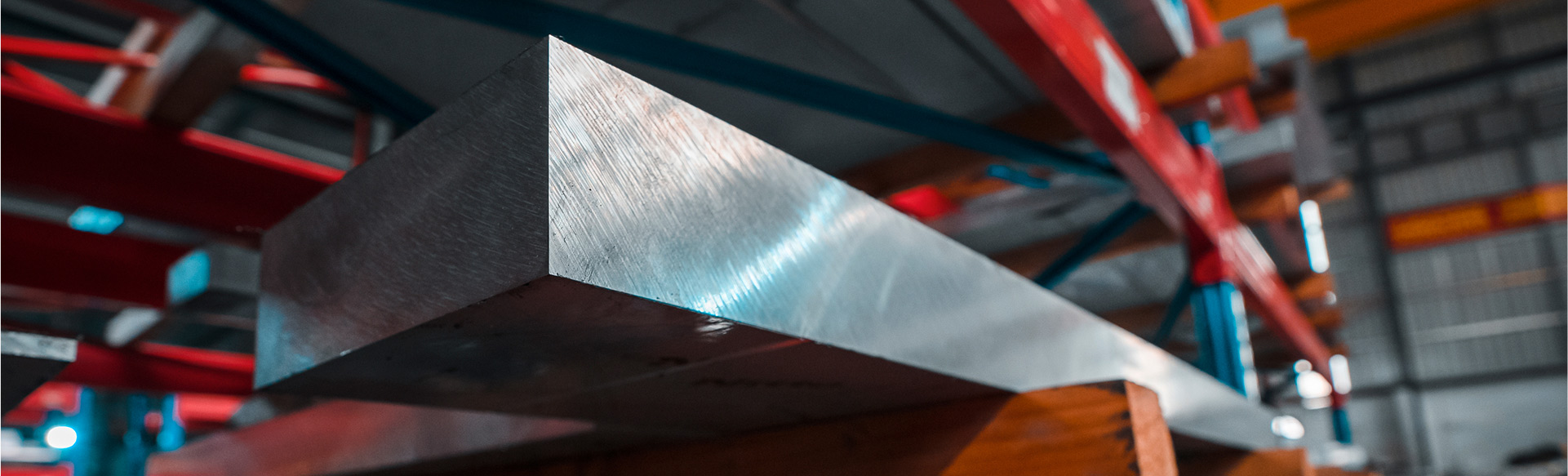
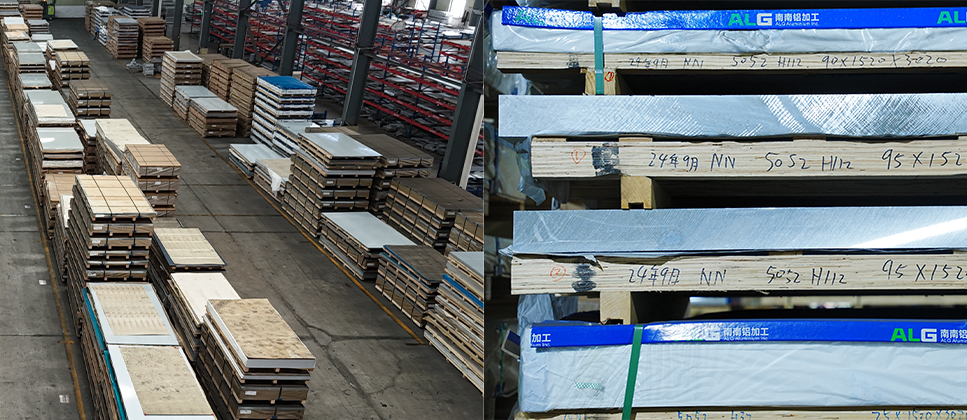
5052 aluminum plate belongs to Al-Mg series rust-proof aluminum alloy, which has excellent corrosion resistance, medium strength and good formability. It is widely used in ships, automobiles, electronics and other fields.
National standard (GB/T): 5052 (old brand LF2).
American Standard (AMS): Corresponding to 5052 (ASTM B209).
ISO standard: AlMg2.5 (ISO 209).
Main component range (mass percentage)
element | Content range (%) |
Magnesium (Mg) | 2.2~2.8 |
Chromium (Cr) | 0.15~0.35 |
Silicon (Si) | ≤0.25 |
Iron (Fe) | ≤0.40 |
Copper (Cu) | ≤0.10 |
Zinc (Zn) | ≤0.10 |
Manganese (Mn) | ≤0.10 |
Other impurities | ≤0.15 (total) |
Features: High magnesium content, copper-free, and excellent corrosion resistance.
state | Tensile strength (MPa) | Yield strength (MPa) | Elongation (%) | Hardness (HB) |
O (Annealed) | 170~210 | ≥70 | 20~25 | 45 |
H32 (semi-hard) | 230~280 | ≥180 | 6~10 | 60 |
H34 (semi-hard) | 260~310 | ≥215 | 4~8 | 68 |
H36 (semi-hard) | 290~340 | ≥250 | 3~6 | 75 |
Features: moderate strength, good plasticity, suitable for stamping, bending and other processing.
Density: 2.68 g/cm³ (slightly higher than pure aluminum).
Melting point: 607~650℃.
Thermal conductivity: 138 W/(m·K).
Electrical conductivity: about 35% IACS (close to pure aluminum).
Thermal expansion coefficient: 23.8×10⁻⁶/℃ (20~100℃).
advantage:
Strong corrosion resistance: especially resistant to seawater and salt spray environments, better than 2A12 (2024).
Good weldability: TIG, MIG, resistance welding, etc. can be used, with little strength loss after welding.
Excellent formability: suitable for cold processing such as deep drawing, stretching, bending, etc.
Convenient surface treatment: good adaptability to anodizing, spraying, electroplating, etc.
shortcoming:
Lower strength: not as good as high-strength aluminum alloys such as 2A12 (2024) and 7075.
Cannot be heat treated and strengthened: Strength can only be improved by cold working hardening (H state)
Shipbuilding: shipboard, oil tank, porthole frame (resistant to seawater corrosion).
Automotive industry: body panels, fuel tanks, decorative parts (lightweight).
Electronic appliances: chassis, heat sinks, battery cases (good thermal conductivity).
Architectural decoration: curtain walls, roofs, billboards (strong weather resistance).
Chemical equipment: storage tanks, pipelines (acid and alkali resistant).
Cold processing: suitable for stamping, bending, and stretching (annealed state O is easier to process).
Cutting: The cutting performance is average, and it is recommended to use sharp-edged tools.
welding:
Recommended methods: TIG welding, MIG welding.
Welding material selection: ER5356 or ER4043 welding wire.
Note: Avoid overheating to prevent intergranular corrosion.
Naturally Corrosion Resistant: Performs well in wet, marine environments.
Anodizing: can improve surface hardness and corrosion resistance (commonly used for sulfuric acid anodizing).
Spraying/electroplating: suitable for appearance parts (such as car decoration).
